
Seed Quality & Premium Traits
WP4: Genetic improvement of quality traits.
WP4 Overview
In the face of climate change and the drive for sustainability, consumers and food manufacturers are turning to pulses as a source of protein and as alternatives to meat. This growing demand places new emphasis on taste, texture, nutritional value, and dietary fibre. This work package focuses on improving the quality traits that make UK-grown legumes attractive for modern diets and premium markets.
Thanks to recent breakthroughs in genome sequencing for pea and faba bean, we can now link important traits directly to their genetic markers, and this means faster progress in breeding.
WP4 aims to provide breeders with the genetic insights and resources needed to:
- Increase seed protein concentration and improve amino acid profiles for plant-based foods.
- Reduce anti-nutrients like phytic acid and enhance mineral content (iron, zinc, calcium).
- Improve starch composition for health benefits and better processing performance.
- Explore premium traits such as seed coat colour and flavour to meet niche market demands.
- Develop marker-based toolkits and gene-editing protocols to accelerate breeding.
By stacking multiple traits (combining quality improvements with pest resistance and climate resilience) WP4 will help breeders deliver varieties that perform well in the field and meet the needs of a growing plant-based market.
Featured review: Nutritional quality traits in pea seed
Researchers involved in PCGIN have published a comprehensive review of nutritional quality traits in pea seed, bringing together the latest knowledge on the genetic and biochemical basis of traits important for human nutrition, food processing, and plant-based food applications. The review covers seed protein concentration and composition, starch and resistant starch, raffinose family oligosaccharides (RFOs), dietary fibre, mineral density and bioavailability, phytate, and sensory traits such as colour and flavour.
Alongside synthesising recent advances in pea genetics and genomics, the review presents new data from diverse pea germplasm collections. Screening of a large pea diversity panel identified accessions with substantially reduced levels of stachyose and verbascose, two major RFOs associated with digestive discomfort, providing promising resources for the development of more consumer-friendly pea varieties. The review also presents diversity data for starch and amylose content, illustrating the scope for breeding varieties with tailored nutritional and processing characteristics.
The review further reports significant natural variation in ferritin abundance, the major iron-storage protein in pea seeds. Together with recent advances in understanding seed iron accumulation and low-phytate traits, these findings highlight new opportunities to improve mineral nutrition and bioavailability through breeding.
By highlighting key discoveries, emerging genetic resources, and remaining knowledge gaps, the review demonstrates how modern genomics, genetic mapping, and germplasm resources can accelerate the development of pea varieties with enhanced nutritional value, improved functionality for food applications, and greater consumer acceptance. These advances support PCGIN’s goal of delivering premium-quality pulse crops that contribute to healthier and more sustainable plant-based diets.
Read the full article:
- Warsame, A.O. & Balk, J. (2026). Nutritional quality traits in pea seed: Current knowledge and opportunities for genetic improvement. Annals of Applied Biology, 189(2), e70145. https://doi.org/10.1111/aab.70145
Increase seed protein concentration
Protein is the top priority for plant-based diets. WP4 screens pea and faba bean diversity panels for protein levels, identifies genetic loci, and makes this information available to breeders.
Why it matters: higher protein pulses support the growing demand for meat alternatives.
Recent PCGIN outputs:
- In the faba bean diversity panel, 2 genetic loci for seed protein content were found.
PhD thesis of Ahmed Warsame, University of Reading (https://centaur.reading.ac.uk/108399/) - In the pea ‘PCGIN’ diversity panel, no significant loci for seed protein content were found. However, wrinkled-seeded varieties have statistically more protein than round-seeded varieties. This is because the block in starch synthesis in wrinkled seeds diverts more carbon into protein. A negative correlation between seed protein and yield was observed in wrinkled varieties, but not in round varieties. Read the Summary Report.
- Pea mutants lacking four or five major storage proteins (vicilins) have a similar seed protein content to the corresponding wild type, with other proteins increased in abundance (Rayner et al, 2025)
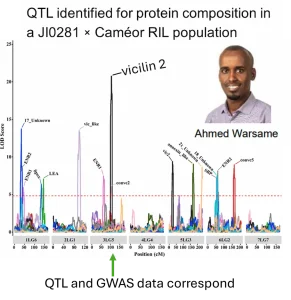
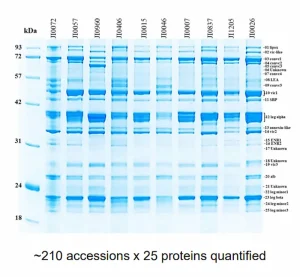
- Diversity in protein composition in pea seeds was characterized in >200 lines of the PCGIN panel. GWAS and QTL mapping identified genetic loci associated with abundant storage proteins or with genes predicted to be involved in protein biosynthesis, trafficking and modification (Warsame et al, 2025). The observed variation may be important for different functional properties of protein extract for industrial uses.
- Diversity in protein composition in faba bean was characterized in 35 lines (Warsame et al, 2020).
Modify protein composition and amino acids
Beyond quantity, protein quality matters. WP4 maps genes controlling storage proteins and amino acid profiles, aiming to improve functional properties for food processing.
Why it matters: better protein composition enhances texture and nutritional value in plant-based products.
Genetic mapping of pea seed protein composition
Researchers for the PCGIN have published their study in The Plant Genome that reveals the genetic architecture controlling pea seed protein composition. Using a genome-wide association study (GWAS) on 209 diverse pea accessions and quantitative trait locus (QTL) mapping in a recombinant inbred population, the team identified multiple genomic regions associated with the relative abundance of major storage proteins such as legumin, vicilin, and convicilin, as well as non-globulin proteins including lipoxygenase, late embryogenesis abundant (LEA) protein, and annexin-like proteins.
One of the most striking findings was the strong influence of the R locus (encoding starch branching enzyme) on protein profiles. Wrinkled-seeded peas carrying the sbeI mutation showed reduced legumin content but increased levels of lipoxygenase, LEA, and certain convicilin isoforms. Beyond this well-known locus, the study uncovered additional regions linked to structural genes and transcription factors, including loci on chromosomes 4, 5, and 6 associated with LEA, annexin-like proteins, and convicilin subunits.
By integrating GWAS and QTL results, the researchers validated five key loci and highlighted candidate genes involved in protein biosynthesis, trafficking, and modification. These findings provide breeders with precise genetic targets for marker-assisted selection, enabling the development of pea varieties with tailored protein profiles for specific end uses such as improved gelling, emulsification, and amino acid balance. This work directly supports PCGIN’s objective to deliver premium traits for UK-grown pulses, ensuring they meet the needs of food manufacturers and the growing plant-protein market.
Read the full article:
- Warsame, A. O., Balk, J., & Domoney, C. (2025). Identification of significant genome-wide associations and QTL underlying variation in seed protein composition in pea (Pisum sativum L.). Plant Genome, 18(2). https://doi.org/10.1002/TPG2.70051
Reduce phytic acid
Phytic acid limits mineral absorption. WP4 identifies and validates low-phytate mutations and develops markers for breeding.
Why it matters: Lower phytic acid improves nutritional quality and digestibility.
Enhance mineral content
Iron, zinc, and calcium are essential nutrients often lacking in plant-based diets. WP4 uses GWAS to find loci for higher mineral concentrations and develops tools for breeders.
Why it matters: mineral-rich pulses support healthier diets.
Improve starch composition
Resistant starch benefits gut health and lowers glycemic index. WP4 screens for genetic variation in starch metabolism and identifies new loci for breeding.
Why it matters: healthier starch profiles make pulses more appealing for functional foods.

Recent analysis of the PCGIN pea diversity panel (derived from the John Innes Centre Pisum collection) revealed extensive variation in starch and amylose content, providing additional resources for breeding varieties with tailored nutritional and processing characteristics. Read the paper here: Warsame and Balk, (2026).
A suite of pea lines for genetic research of starch and protein quality
A collaboration of researchers, including members of PCGIN, have developed and characterised a unique set of Near-Isogenic pea Lines (NILs) carrying mutations in key starch biosynthesis genes. This resource provides breeders with powerful tools to tailor seed carbohydrate and protein profiles for food, feed, and industrial applications.
Their study reports 27 NILs representing alleles at six loci:
- Five rugosus loci (r, rb, rug3, rug4, rug5) – mutations reduce starch content and alter granule structure, producing wrinkled seeds.
- lam locus – mutations lower amylose content without reducing total starch, resulting in smooth seeds.
These loci encode enzymes central to starch biosynthesis, including starch branching enzyme (SBEI), ADP-glucose pyrophosphorylase (AGPL1), plastidial phosphoglucomutase, sucrose synthase, starch synthase II, and granule-bound starch synthase I. Structural modelling using AlphaFold2 revealed how specific amino acid changes disrupt enzyme folding, active sites, or oligomerisation, explaining the observed phenotypes.
Breeding impact:
- Mutants with severely reduced starch (e.g., rug3) offer seeds enriched in protein, ideal for plant-based protein extraction.
- Lines with contrasting starch types (high amylose vs. low amylose) enable development of products with tailored digestibility and processing properties.
- Molecular markers for each mutation (including KASP™ assays) allow rapid introgression into elite varieties.
This resource supports PCGIN’s goal to improve seed quality and premium traits, combining starch variation with protein quality improvements for new pea cultivars.
Read the full article:
What are Near-Isogenic Lines (NILs)?
Near-isogenic lines are plant lines that are genetically almost identical, except for a specific gene or small genomic region of interest. They are created by backcrossing a mutant line to a standard parent line multiple times, so the background genome matches the parent while retaining the mutation at the target locus.
NILs enable us to study the effect of a single gene without interference from other genetic differences, which is ideal for functional studies, QTL validation, and marker-assisted breeding. They also provide ‘clean’ genetic resources for introducing specific traits (e.g., altered starch or protein composition) into elite varieties.
Screen for premium traits
Seed coat colour, flavour, and other niche traits can add value for specialty markets. WP4 will identify genetic variation and develop markers for these premium characteristics.
Why it matters: premium traits create new opportunities for UK-grown pulses.
Trait stacking and Breeder's toolkit
WP4 will compile markers and germplasm for stacking multiple traits- quality, resilience, and resistance – into new varieties. A breeder’s toolkit is under development and will be published on the PCGIN website.
