
About PCGIN
The Pulse Crop Genetic Improvement Network (PCGIN) was established in 2005 and led by Claire Domoney until 2024. We are now in our fifth phase, under the leadership of Janneke Balk and Sanu Arora. On this page, we invite you to learn more about our Project Outline, Partner Organisations, Management Team, Defra and Industry Representatives, as well as our History and Impacts.
Project Outline
Welcome to the 5th phase of PCGIN (2024 - 2029)
The Pulse Crop Genetic Improvement Network (PCGIN) is a Defra funded initiative supporting the genetic enhancement of UK pulse crops. The previous programme ran from 2018 – 2024 (5 years plus 1 year extension due to the pandemic) with a budget of £1.5m. This budget was doubled to £3m for the current five-year programme. Our network focuses on faba beans (field beans, Vicia faba) and peas (Pisum sativum), and in the current phase has expanded to include other pulses such as lentils (Lens culinaris) and common beans (Phaseolus vulgaris).
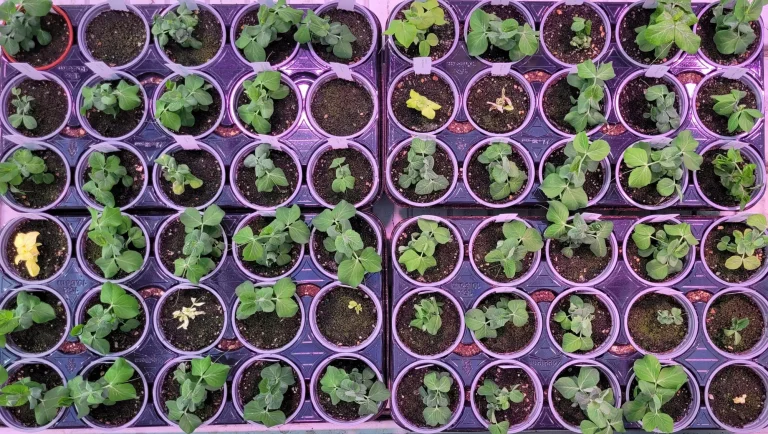
During the current phase, we will continue our focus on disease resistance and nutritional improvement in faba bean and pea, as well as aim to develop a service pipeline for gene editing in faba bean and pea for accelerating breeding innovation. We are also expanding our scope to curate foundational resources for other pulse crops, and we will be collaborating with the Met Office to address emerging challenges linked to climate change.
Research objectives and updates
The current PCGIN is arranged into four complementary Work Packages.
- WP1: New genetic resources for pea, faba bean and other grain legumes.
- WP2: Enhance genetic resilience against pests and diseases.
- WP3: Building climate-resilient legumes through genetic improvement.
- WP4: Genetic improvement of quality traits.
Shaped with input from our wide stakeholder community, our programme aligns with Defra’s four overarching priorities to:
- Enhance productivity and food security,
- Improve environmental sustainability, including pest and disease resistance,
- Build resilience to climate change,
- Improve nutritional and other quality traits.
Explore the dedicated pages for each of our four work packages to learn more.
We share milestone progress through our regular Newsletters, recent highlights include:
Genetic Resources & Diversity (WP1)
- Development of mutant populations in pea and faba bean for trait discovery (Nov 2024).
- Creation of a “Panel of Panels” of faba bean diversity and multiplication of ICARDA lentil collection for UK trials (May 2025).
- Survey of UK germplasm collections identified 600+ pulse varieties available for research (Nov 2025).
Disease and Pest Resistance (WP2)
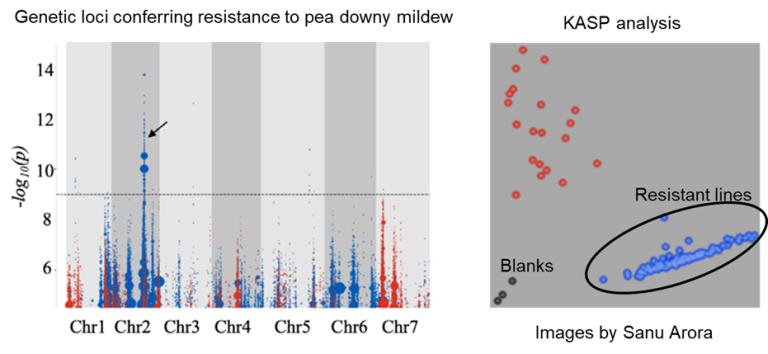
- Progress on downy mildew resistance in pea and foot/root rot resistance in faba bean, including QTL mapping and marker development (Nov 2024 & Nov 2025).
- Launch of virus resistance screening in pea using innovative Agrobacterium-based infection system (Nov 2025).
- Research into Bruchid beetle resistance in faba bean, including controlled infestations and molecular studies (Nov 2025).
Climate Resilience (WP3)
- Collaboration with the Met Office to model climate risks for peas and beans, including heat-induced flower abortion and pest migration (May 2025).
- Screening for drought tolerance, root architecture, and heat tolerance in pea and faba bean (Nov 2024).
Seed Quality & Premium Traits (WP4)
- Identification of premium quality traits to improve farm-gate prices for UK pulses (May & Nov 2025).
- Large-scale analysis of variation in pea seed protein composition (209 lines) and mapping of associated genes (Nov 2024 & Nov 2025).
- Industry uptake: data now being used to develop genomic models for processing industry (Nov 2025).
Partner Organisations and Management Team
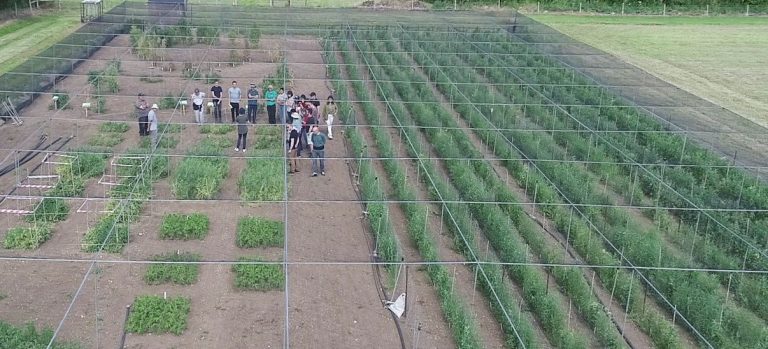
The Pulse Crop Genetic Improvement Network is managed by the John Innes Centre in collaboration with NIAB, University of Reading, IBERS / University of Aberystwyth and PGRO, with input provided by the commercial sector.
The Programme Management Team (PMT) meets every four months to discuss research and the delivery of milestones.
PCGIN Management Team (October 2024)

Prof. Janneke Balk, JIC
Started her independent research career at the University of Cambridge in 2005 and has been a group leader at JIC since 2011. Her expertise is in biochemistry and genetics, focussing on mineral transport in plants, including nutrient accumulation in seeds and iron delivery to nitrogen fixing nodules of legumes.

Dr Sanu Arora, JIC
Group leader at JIC since 2020 funded by a Ben Gill Translational fellowship to foster interactions with industry. Her work focuses on understanding the molecular basis of diseases affecting the pea crop, including downy mildew, root rot and viruses. For this she has developed novel gene discovery pipelines using the latest bioinformatics tools.

Prof. Donal O’Sullivan, UoR
Donal has been involved in legume improvement since his 1997 PhD on common bean anthracnose and has been a co-investigator of PCGIN since 2010. His research team has been at the forefront of developing and characterising high quality inbred diversity collections and mapping populations for faba bean.

Dr Tom Wood, NIAB
Tom is a senior program leader in the Plant Pathology Department and has worked on PCGIN since 2012. Tom’s research utilizes genetics and genomics techniques to improve understanding of host-pathogen interactions in faba and common bean.

Becky Howard, PGRO

Dr Catherine Howarth, IBERS, Aberystwyth University

Dr Noam Chayut
Noam is an applied crop geneticist who has led the Germplasm Resource Unit team since 2018. He represents the John Innes Centre in the UK Plant Genetic Resources Group and also in the platform of Access and Benefit Sharing for the Nagoya Protocol. He is a member in the European Cooperative Programme for Plant Genetic Resources, in the working groups for wheat and grain legumes.
Defra representative
Helen Riordan
- Defra Project Officer
Industry representatives
Rebecca White
David Lloyd
Elise Cocciantelli
Panida Wadsworth
History and Impacts
A brief history of PCGIN and impacts
The Pulse Crop Genetic Improvement Network started in 2005 and was led by Prof Claire Domoney until 2024.
Summaries and reports of previous phases can be found on Defra archives:
- PCGIN 2018-2024 – PCGIN: Pulse Crop Genetic Improvement Network CH0111
- PCGIN 2015-2018 – Pulse Crop Genetic Improvement Network – CH0103
- PCGIN 2009-2014 – Defra Pulse Crop Genetic Improvement Network – IF0147
- PCGIN 2005-2009 – The Defra Pulse Crop Genetic Improvement Network – AR0711
The outcomes of the GINs were recently reviewed by Prof Andrew J Thompson of Cranfield University on behalf of Defra (read the review here). The review estimated the GINs delivered a 26-fold return on investment, with annual benefits to UK agriculture between £30-£49 million, compared to an average annual investment of £1.15 million. These gains come from improved yields, reduced input costs, better market value for crops and seed sales for breeding companies.
One of PCGIN’s impactful outputs has been our contribution to the identification of the genes for vicine and convicine in field beans (Vicia faba). The proteins are allergens that cause favism in people with a genetic disposition. The research enabled the development of low vicine/convicine (LVC) varieties that were released by NPZ (Formerly LS Plant Breeding), which are safer for human consumption and more efficient in animal feed.
The economic value of this innovation is significant:
- LVC beans have expanded marketability for UK-grown pulses in both food and feed sectors.
- They enable higher inclusion rates in monogastric animal feed, reducing reliance on imported soy.
This success highlights how targeted genetic research in pulses can deliver tangible public good and economic returns.
Another example is disease resistance to chocolate spot and downy mildew, with germplasm of both field bean and pea being used in current breeding programmes by Limagrain.
Coming soon… we will be updating PCGIN history and impact, in the meantime please see the Pea TimeVine at the JIC, which documents 160 years of pea research at the John Innes Centre.
What are the GINs?
The Genetic Improvement Networks (GINs) are long-term research partnerships funded by Defra. They aim to advance understanding of how genetic improvement of crop varieties can contribute to sustainable food production, addressing the twin challenges of food security and climate change.
GINs tackle key issues such as disease resistance, climate resilience, and nutritional quality, creating valuable resources for breeders and farmers. They cover major UK crops including wheat (WGIN), oilseeds (OREGIN), pulses (PCGIN), vegetable crops (VeGIN), and soft fruits (SFGIN).
A core focus of the GINs is pre-breeding research, which develops traits, tools, and knowledge that deliver public-good benefits but fall outside the scope of commercial breeding. This work often involves genetic resources such as wild relatives, landraces, and diverse related varieties, ensuring access to a broad genetic base for future crop improvement.