
Faba beans
Vicia faba L.
Faba bean (Vicia faba L.) overview
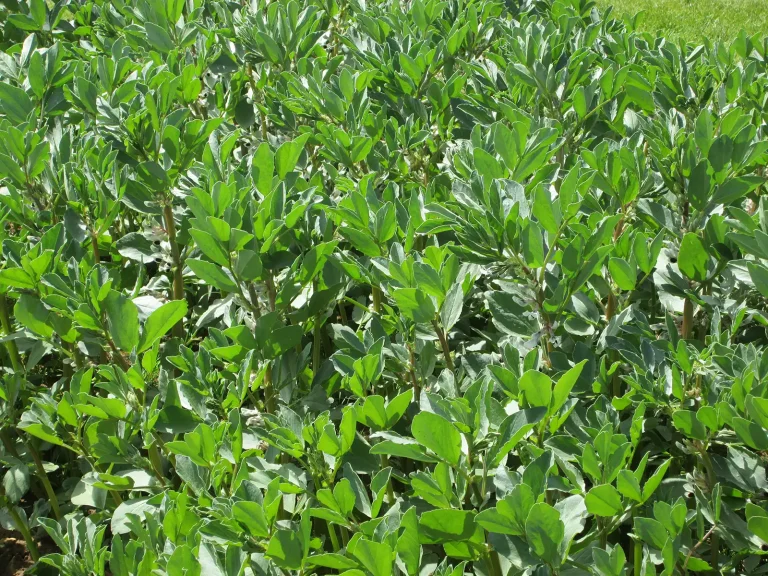
Faba bean (Vicia faba L.), also known as fava, horse, tic, or field beans, is a cool-season grain legume crop grown globally for feed and food. It is easily recognised by its upright growth habit, thick stems, and large, compound leaves with 2-6 leaflets. The plant produces distinctive white flowers marked with black spots, which are attractive to pollinators. Pods are elongated and leathery, and typically contain between 3-8 large seeds.
Faba beans thrive in temperate regions, and the most recent FAOSTAT data show that in 2023 the UK was the third largest producer of dry faba beans, after China and Ethiopia. In the UK faba beans are sown in autumn (as winter types) or early spring (as spring types), depending on local conditions. Cool weather is ideal during vegetative growth, while moderate temperatures are preferable for flowering and pod filling. The crop is commonly included in cereal rotations due to its ability to fix atmospheric nitrogen through symbiosis with rhizobium, which enhances soil fertility and reduces the need for synthetic fertilisers in subsequent crops.
The species is partially allogamous, meaning it can self-pollinate but also benefits from cross-pollination. Outcrossing rates vary widely (10-70%) depending on genotype and environmental conditions, with pollinators such as honeybees and bumblebees playing a key role. These flowering plants provide valuable forage for pollinators, supporting biodiversity within agricultural landscapes. The crop’s mixed mating system influences breeding strategies and genetic diversity. Harvest usually takes place when the plants reach full maturity, ensuring maximum seed quality and yield. After combine harvesting, seeds are dried to a safe moisture level (around 14%) to maintain quality during storage and processing.
Genomic characteristics
One of the most striking features of faba bean is its genome size: approximately 13 gigabases, making it one of the largest diploid crop genomes (it is often described as ‘bloated’ and is four time larger than the human genome). The huge genome is highly repetitive, which historically slowed the development of genomic tools. However, the publication of a chromosome-scale reference genome in 2023 has transformed research, enabling high-resolution genetic mapping, genome-wide association studies, and genomics-based breeding.
Nutritional characteristics and market context
Faba bean seeds are rich in protein, typically 25-37%, making them a valuable source of plant-based protein for both animal and human diets. In the UK, the crop is primarily grown for animal feed, where its high protein content and energy value make it an attractive alternative to imported soybean meal. Aquaculture demand is also growing in Scotland and Scandinavia, as de-hulled beans are a good source of high protein feed for farmed salmon and trout. High quality seed, having the right visual qualities and without bruchid damage, are exported to North African countries such as Egypt and Sudan for human food. Nutritional quality for feed and food is influenced by both storage protein composition and the presence of anti-nutritional factors.
Protein Composition
- Around 80% of seed protein is made up of globulins, mainly legumin (11S) and vicilin/convicilin (7S). The numbers refer to their sedimentation coefficients in Svedberg units, which reflect molecular size and structure: 11S proteins are larger and more compact, while 7S proteins are smaller and less dense. This distinction is important because 11S globulins generally provide better gelling and emulsifying properties, whereas 7S globulins contribute to solubility and foaming, influencing both nutritional quality and functional performance in food applications.
- Legumin typically accounts for ~50% of storage proteins, while vicilin/convicilin contributes ~27%.
- The legumin:vicilin ratio varies widely among genotypes (1:1 to 1:3) and affects levels of sulphur-containing amino acids (S-AA), which are important for feed efficiency and nutritional quality.
- Breeding strategies aim to increase legumin content because it is richer in methionine and cysteine compared to vicilin
Anti-Nutritional Factors
- Vicine and convicine: Naturally occurring glycosides that can cause favism in susceptible humans and reduce feed efficiency in monogastric animals. PCGIN contributed to the identification of the genes for vicine and convicine in field beans (Vicia faba). Breeding programs have now developed low-vicine/convicine lines using molecular markers.
- Seed coat tannins: Reduce protein digestibility and palatability in feed. Zero-tannin varieties are available and are a priority for feed markets.
- Lipoxygenase: An enzyme that promotes lipid oxidation, leading to off-flavours in food and potentially affecting feed quality. Variation exists among genotypes, and breeding for low-lipoxygenase content is possible.
Food use
Faba bean potential in human diets is now gaining momentum through initiatives such as:
- Raising the Pulse (a Transforming UK Food System project): Explored ways to incorporate faba bean flour into staple foods like white bread to boost plant protein intake without changing consumer habits.
- Scottish Adapted Baked Beans (James Hutton Institute): Developing a dwarf faba bean variety suited to Scotland’s climate for use in baked bean products, aiming to replace imported haricot beans and support local supply chains, school meals, and sustainable diets.
And, innovators Hodmedod’s have long championed British-grown pulses, raising awareness and creating new markets for faba bean in snacks, flours, and everyday meals. These efforts highlight the crop’s versatility and its role in building resilient, sustainable food systems.
Further reading...
For readers interested in the broader context of faba bean genetics, breeding, and genomics:
- O’Sullivan, D. M., & Angra, D. (2016). Advances in Faba Bean Genetics and Genomics. Frontiers in Genetics, Volume 7-2016. https://doi.org/10.3389/fgene.2016.00150
- A historical perspective on cytogenetics and the transition to modern molecular tools.
- Adhikari, K. N., Khazaei, H., Ghaouti, L., Maalouf, F., Vandenberg, A., Link, W., & O’Sullivan, D. M. (2021). Conventional and Molecular Breeding Tools for Accelerating Genetic Gain in Faba Bean (Vicia Faba L.). Frontiers in Plant Science, 12, 744259. https://doi.org/10.3389/FPLS.2021.744259
- Comprehensive review of breeding strategies, marker-assisted selection, genomic selection, and speed breeding.
- Jayakodi, M., Golicz, A. A., Kreplak, J., Fechete, L. I., Angra, D., Bednář, P., Bornhofen, E., Zhang, H., Boussageon, R., Kaur, S., Cheung, K., Čížková, J., Gundlach, H., Hallab, A., Imbert, B., Keeble-Gagnère, G., Koblížková, A., Kobrlová, L., Krejčí, P., … Andersen, S. U. (2023). The giant diploid faba genome unlocks variation in a global protein crop. Nature 2023 615:7953, 615(7953), 652–659. https://doi.org/10.1038/s41586-023-05791-5
- Publication of the first chromosome-scale reference genome for faba bean, enabling genomics-based breeding.
- Mouritzen, T. W., Meurer, K. H. E., Bornhofen, E., Janss, L., Weih, M., & Andersen, S. U. (2025). Faba bean genetics and crop growth models – progress to date and opportunities for integration. Plant and Soil, 514(1), 47–64. https://doi.org/10.1007/s11104-025-07459-7
- Discusses integration of genomic prediction with crop growth models for future improvement.