
Stakeholder Meeting at PGRO, Peterborough
The 2026 edition of the stakeholder meeting (3 February) was held at the Processors and Growers Research Organisation (PGRO) near Peterborough, who ensured a smooth and enjoyable day for all attendees. The previous two years, the meeting was held back-to-back with the UK Legume Research Community meeting, but this year the latter takes place in May in Dundee, Scotland.
Our PCGIN meeting brought together a total of 58 people. Approximately 55% of attendees were representing academia of 14 different institutes and universities, and 45% of attendees were representing industry stakeholder organisations, from 18 different industry affiliations. The programme followed the familiar structure: updates on PCGIN research, perspectives from industry, student/ECR presentations, and invited speakers.
Updates on PCGIN Research
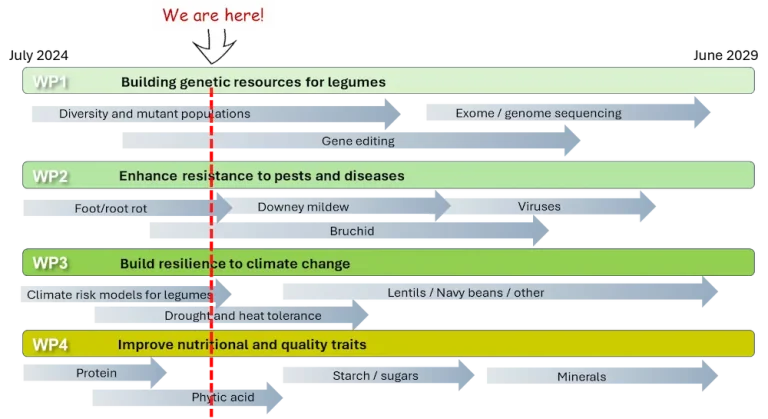
Although each talk could easily fill an hour, the research leads of the PCGIN partner organisations delivered concise and engaging summaries of the latest progress within the 5-year programme. Janneke Balk (JIC) updated on the new EMS mutant population in pea which is being generated at JIC and the University of Oxford. JIC has now phenotyped ~3000 M2 lines and 28 lines have been genome sequenced, revealing that the number of mutations is rather variable, from 3 – 600 in the so-called gene space. Examples of how this mutant population can be used included testing novel A locus alleles (pigmentation of flowers and seed coats) for disease resistance, or for finding mutant alleles in any known gene through a TILLING pipeline (Targeting Induced Local Lesions in Genomes).
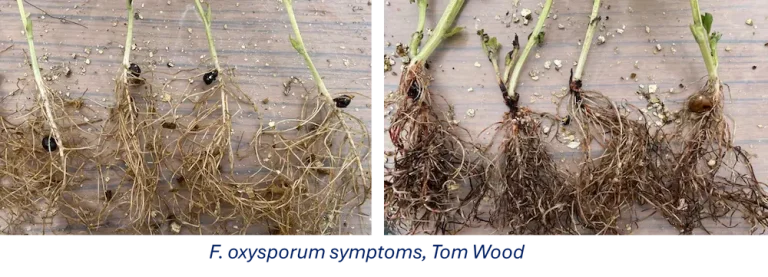
Tom Wood and his NIAB colleagues have continued to screen a diversity panel of faba bean for resistance to foot rot and root rot pathogens, which cause up to 50% yield losses. The incidence is increasing because of warmer temperatures, water logging and shorter rotations. Screening of 250 lines from a diversity panel has been carried out using two foot rot pathogens, Fusarium avenaceum and F. oxysporum, applied individually. Absence of very low level of disease symptoms was found in 10 – 20 plant lines for each pathogen, indicating novel sources of resistance. The lines will be screened again in 2026 and crossed into elite varieties to pyramid resistance, as well as nested association mapping by crossing of resistant lines with a common susceptible parent.
Catherine Howarth (IBERS, Aberystwyth) brought us back to peas. Using their National Plant Phenomics Centre with automated phenotyping platform they have screened 260 sequenced lines under control and 2-water limiting conditions. They identified lines with contrasting performance (growth rate and water-use-efficiency), which will enable identification of genes associated with drought tolerance to use in breeding programmes. Preliminary bioinformatics analysis re-identified a major gene for plant height, indicating the power of the systematic approach. As well as follow up experiments to test genomic predictions, they will screen a number of lentil lines from the ICARDA collection recently acquired by the JIC Germplasm Resource Unit.
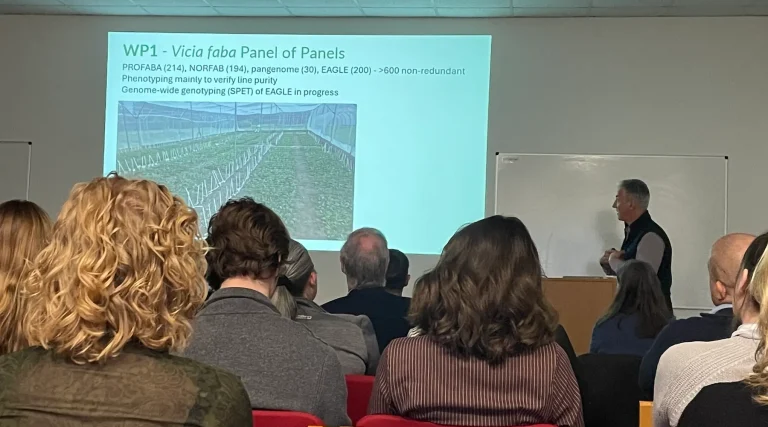
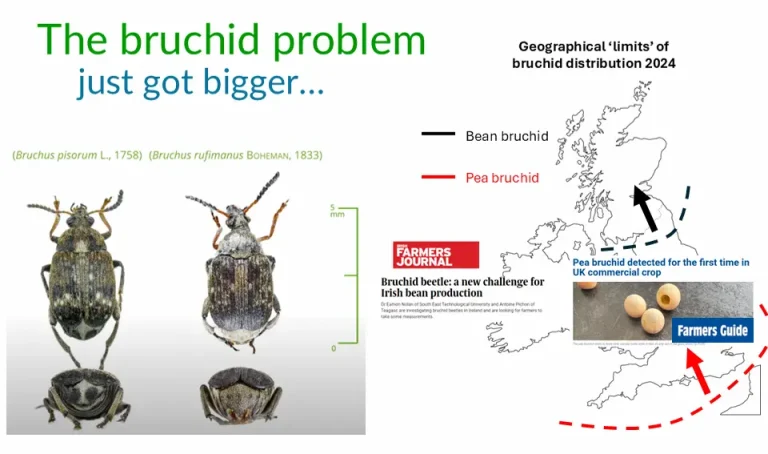
Donal O’Sullivan gave updates on the faba bean research at the University of Reading, including collaborations on the pan-genome and single cell gene atlas resources. The latter details the expression level and patterns of genes within tissues, including developing seeds. Donal balanced the bad news with optimism when he came to one of the hottest topics: bruchid beetle. Faba bean bruchid is found throughout England, having reached the Scottish border. The PhD project of Matt Pratley is focussing on understanding the molecular interactions between the host plant and insect pest. In addition, Donal’s lab has won funding for a new iCASE PhD project, together with the breeding company NPZ and colleagues at Royal Holloway, to develop an RNA interference strategy in faba bean, targeting the bruchid larvae.
The final update from the PCGIN team came from Noam Chayut, who leads the Germplasm Resource Unit (GRU) at JIC, together with Phil Howell from NIAB. Through surveys and desk‑based research, the team has been mapping pulse crop germplasm resources that are publicly available for the research community in the UK. The response from 27 organisations identified a number of germplasm collections for faba bean and pea and 1 – 2 collections for each of chickpea, lentil, soybean, common bean and lupin. In addition, >600 faba bean, pea, bean, soy and lupin varieties occur on current UK National Lists.
Perspectives from Industry
The industry sessions provided valuable insights into the commercial realities of pulse production, processing, and market dynamics.
Andrew Whiting (Nomad Foods) offered an overview of the vining pea sector and highlighted several challenges facing the industry. Small plot replicated trials have been discontinued and replaced with 1-2 ha field plots. Cost vs value is key: higher numbers of peas per pod result in a higher yield, requiring less seed/ha for sowing, less pesticides and fewer machine runs to harvest. In the cost/process analysis, CO2 is also included. Despite strong consumer enthusiasm for plant‑based foods, the market share of green peas is gradually declining in the UK, although the export market remains strong.
Justin Barrett (Askew & Barrett) delivered a practical perspective on how pulse quality affects growers’ gross margins and how stringent customer requirements shape the industry. He illustrated the processing of pulses once they arrive from the field, including cleaning, grading and colour sorting. His numbers showed that colour retention (lack of bleaching of green-seeded varieties) is better for the sales value than yield. Records of Thousand Seed Weight going back to the 1980s suggest that peas are getting smaller, unless there has been a change in how TSW is measured. Customer demands are for larger peas, however, and batches with too much size variation end up as animal feed for a much lower price. Justin’s view on intercropping, from a processor’s perspective, is that it is incompatible with obtaining a premium for allergen-safe produce.
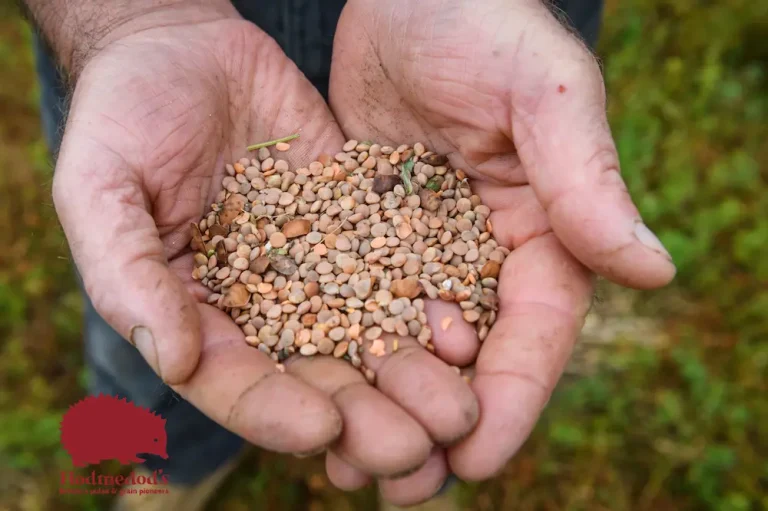
Josiah Meldrum (Hodmedod’s) spoke about the need to move from linear UK food supply chains toward more collaborative and resilient networks. Using the Berkana Institute’s “two loops” model, he described pressures on the current agri‑food system and the emergence of community‑driven alternatives. He outlined Hodmedod’s shift from NGO to business, early chickpea trials in 2015, and lentil trials where two varieties proved viable in the UK. Hodmedod’s now works with a small group of farmers (typically up to 20 ha each) on a premium pricing model that accounts for periodic crop failure, producing around 100 tonnes of UK pulses for food manufacturers. He referenced wider initiatives promoting pulse consumption, such as “Raising the Pulse” and “Beans is How”. He also commented that peas for the ingredient market do not appear to be gaining traction so far, contrary to expectations as a result of climate policies.
Student and Early Career Researcher presentations
This fast-paced session showcased emerging talent from across the legume research community. Each speaker delivered a five‑minute presentation followed by short questions.
- Emily Guest (Cranfield University): “Climate-smart nitrogen management: Sensor-based insights into legume-based crop rotations”
- Oona Hinshelwood (Quadram Institute): “Gut microbiome-mediated health benefits of pea bioactives”
- Samuel Bruty (JIC): “Recipea for a modern microbiome: uncovering the genetic basis of domestication linked microbiome traits in Pisum”
- Charlotte Apsey (University of Cambridge): “Optimising the pollination of Vicia faba”
- Lucy Bentall (University of Cambridge): “The potential of ‘persistent’ viruses to enhance performance of Vicia faba”
Invited speakers
The final part of the programme featured two expert talks providing wider perspectives on plant health and climate resilience.
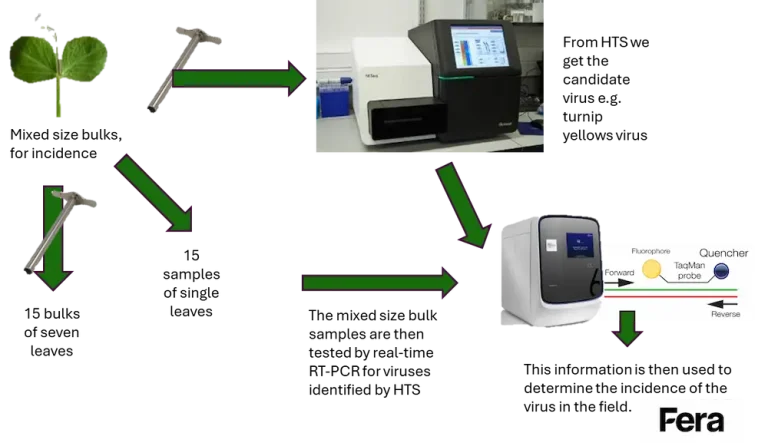
Aimee Fowkes (Fera Science Ltd) presented an overview of her team’s work developing a surveillance workflow for viruses in UK peas and beans. As the national reference laboratory for plant health, Fera has traditionally relied on targeted diagnostics such as ELISA and PCR, but Aimee highlighted how high-throughput sequencing (HTS) enables the detection of any nucleic acid in a sample, and with it the identification of novel viruses or known viruses in unexpected hosts. Her AHDB‑funded project revealed several viruses not previously reported in UK peas and confirming significant yield impacts associated with Turnip yellows virus and Pea enation mosaic virus (photo).
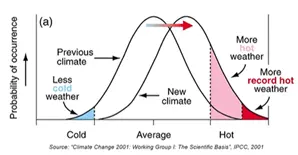
Tom Crocker (Met Office) delivered the final talk of the day online, presenting his work with PCGIN on assessing future climate risks for UK legumes. Climate projections consistently show hotter, drier summers and milder, wetter winters in the UK, alongside more frequent and intense extremes such as heatwaves and heavy rainfall. These trends translate into agricultural risks, including heat and drought stress, waterlogging, flooding, and increased pressure from pests, diseases and invasive species. Model simulations indicate that heat stress events above 30°C, historically rare for peas, are projected to rise significantly (particularly in central and southern England) with multiple events per year expected by the 2040s-2060s. He also introduced the use of climate analogues to understand which global regions currently resemble the UK’s projected future climate, providing clues about crop suitability and adaptation strategies.
Tom Crocker, Met Office
The meeting concluded with strong engagement and a clear sense of shared purpose across research and industry. The breadth of work presented underscored both the challenges and the substantial opportunities for UK pulses in an evolving climate and market landscape, and reaffirmed the value of continued collaboration across the PCGIN community.